Monday, February 16, 2015

Relaxing in Florida

It is now Monday night and I'm back on schedule. After breakfast, Jean and Anna (her daughter-in-law) went to the beach while I filed the previous entry, then took a nap. It was colder than they would have liked for beach weather, but they enjoyed it anyway.

After lunch, we went back to the river to look for manatees. There were a few there but there was more wind than yesterday and the waves reflected the sun so that we couldn't see below the surface. Manatees don't breathe frequently, and when they do they just stick a nose above the surface for a second or so. No manatee pictures today, but walking around the neighborhood there were lots of birds.

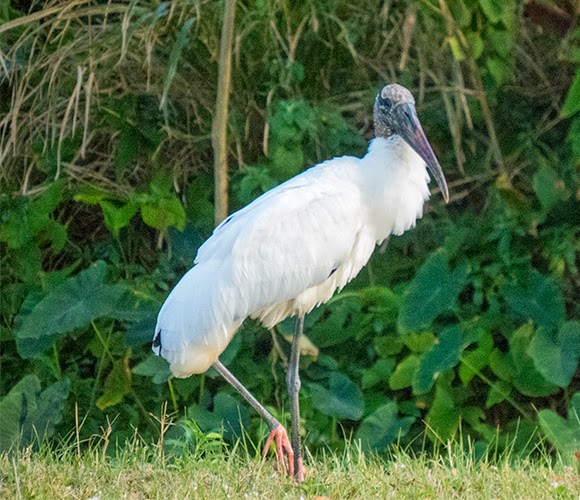
Wood stork

Ibis
Egret


These birds were spotted in a short walk around the neighborhood.


There were also the usual ospreys and herons --- ho hum.


Anna also took us to a favorite view of hers:


                                    under a bridge


Basically a quiet day in Florida. While I am writing this blog, Jean is in the motorhome making baklava for the upcoming birthday celebrations (we're bunching them together). Don't know what is planned for tomorrow, but I will let you know --- with pictures.

Back to Florida

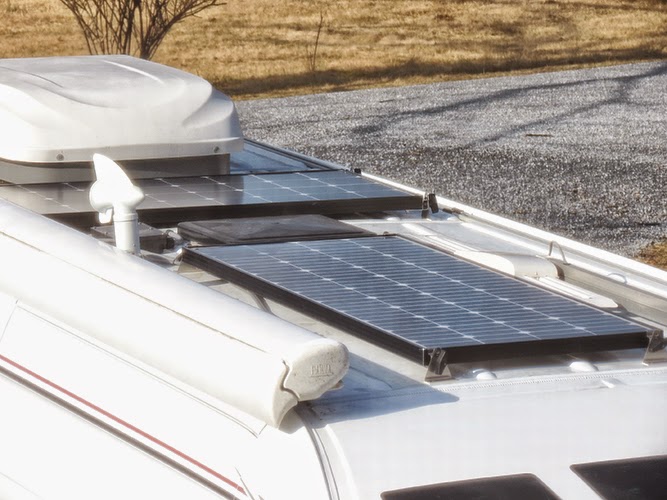
It's winter and Virginia is colder than we like. It must be time to head to Florida like we do every February. This year we are adding to the adventure. Gene bit the bullet and had two solar panels added to the roof of the Roadtrek. They take up most of the available space and put out up to 230 watts in ideal conditions (which you almost never see).


This trip should be a good chance to see if they will do what I hoped --- allow us to park for several days without having to be plugged in.

So off we went on a chilly Friday the 13th (you're leaving on Friday the 13th? Are you mad?). As it turns out, we got out of town just before the real cold weather hit. As usual for these trips, the first three days were spent just getting ourselves to the real action. Get on the road and just make miles. The first night was in a Cracker Barrel outside of Charleston, SC; the second night in a campground just over the Florida border. A crowded place off the interstate full of very friendly people. After a free dinner of spaghetti, we got down to the reason we were there --- to dewinterize the rig; get rid of the anti-freeze and fill up with water.

The next day we drove pretty much the length of Florida (about 280 miles of it anyway) and arrived at Sandy's (Jean's son) in Palm City about 4:45. Along the way we bought a Sun Pass (for Florida toll roads) but hadn't registered it yet, so when the GPS routed us onto the Florida Thruway we still had to pony up. Grrrr! The whole way down the van was displaying an "oil high" light which worried me. So Sandy arranged for his mobile mechanic to come by Monday.

When we arrived, after a short time we all piled into Sandy's van and went to a river where manatees had been spotted. We were in luck, they were still there.


This is the river. It is right in the middle of lots of housing,


 but there were several manatees cruising back and forth.
They were hard to see late in the day, but this cow and calf came up near the surface. We were excited.


Then off to another beach to watch the sunset. Kind of hazy, so it wasn't as spectacular as it sometimes is.

When we got back to the house, I noticed that the new battery meter was showing that the battery was dangerously low. I suddenly realized that when we had parked I forgot to switch the refrigerator over to propane. It had been operating on battery the whole time we were gone. Put in some new equipment and you have to develop new habits. It's like starting all over again, with the same steep learning curve.

When I switched the fridge over, the battery level came up slightly, but still dangerously low. We ran the furnace (a notorious power hog) a little during the night (it was still chilly even in Florida). About 4:30 in the morning (now Monday) it was about rock bottom, so I started the engine. Even though the engine was just idling, it was putting out some power to the battery.

I ran the engine until about 7:30. The meter showed that the battery had gained some and now the rising sun was dribbling a few electrons into it. We will see how we stand at the end of the day. We are going to try to see if we can survive the week without having to run an electric cable to the house.

Later on in the morning, Sandy's mechanic turned up and examined the oil situation. His conclusion was that the oil level was okay, but the sensor was going.  I should have it replaced when we get back home. We will continue on that advice and check the oil every morning.

Now (1:00 pm) everyone is out except this Gene. I will post this (and probably take a nap) now and perhaps get on a schedule tonight or tomorrow. Maybe even have some more manatee pictures.

Wednesday, October 8, 2014

Last two days

Okay, let's try this one more time. Lat night (Tuesday) we were at a great state park campground, the best yet. Unfortunately we couldn't get enough cell signal to run the hot spot (I use my smart phone). Tonight we are at another state park and we couldn't get signal when we parked. Now it is after dark and it seems to be working, so here goes.

Yesterday I ran the usual pre-departure check of the tires and found that the right rear was over 30 pounds low. I carry an electric tire pump, and so pumped it back up again --- but it is a very slow process. So our first order of business was to get the tire taken care of.

Off we went, and stopped briefly for some donuts for breakfast. I checked the tire again and found it had gained 2. 1/2 pounds. Then we drove toward Salisbury to an RV dealer we had spotted on the way out. I didn't expect them to fix the tire, but I figured they could recommend a tire place that was familiar with light truck tires. They were and did. That took us into the heart of Salisbury, a place we wanted to avoid. However, Mr.Tire took us right in and found that we had picked up a screw. $25 and change and we were on our way.

Heading south, our first stop was Princess Ann. We were determined we were going to see it, and it was pretty much on our way anyway. It turned out to be as advertised. We parked downtown (not much happening) and walked around a little. There were the old buildings, some of them impressive, many just old.


Oldest house in Princess Ann, 1744


Even the police station is old.
We made it a point to see the old Presbyterian church, since Jean was raised Presbyterian.


The sign says that it was one of five churches started by Francis Makemie, (founder of Presbyterianism in America).
This guy keeps showing up on the Easteran Shore.

After Princess Ann, we headed to Deal Island, one of the three island in Chesapeake Bay that are the heart of crabbing and oystering. It is the only one you can drive to. We drove all the way to Wenona, the town at the farthest end of the island. There we saw lots of deadrise boats, and a couple of skipjacks.


 Skipjacks are the iconic image of Maryland. They are the last working sail in America. During the fall and winter season they dredge for oysters, a hard and sometimes dangerous life. They exist because Maryland enacted a law, meant to help conserve oysters, that they could only be dredged under sail. All the skipjacks are old, there haven't been any new ones constructed in decades.


Deadrise boats are the most common waterman's working boats in both Maryland and Virginia. They are usually built by the owner and so there is some variation, but the basic working design is the same. They use these boats for all the Chesapeake fishing: crabs, oysters, and netting fin fish.


This is a picture of  the most common equipment used on the Bay: crab pots, oyster dredges, and patent tongs (used in Maryland for both oysters and clams). On the way out we spotted this skipjack, prettied up for taking tourists out sailing.


Our next stop was Crisfield, which bills itself as "the seafood capital." Thanks to the delay caused by the tire problem, we ran out of time and instead checked in to Janes Island State Park right near Crisfield.  We'll pick up the story at Crisfield tomorrow.


So it's now tomorrow (Wednesday).


Janes Island turned out to be the best campground of the trip. Here's the view from our campsite:


All this and first-class facilities too (no water). As you can see, the marshes are already turning brown for the winter.

Anyway, it's on to Crisfield. We drove right down the main street to the pier at the end. This is where the mail boats and the ferry boats to Smith and Tangier Islands (the other two watermen islands) leave. The boats run out into the Bay all year round, so they need to be able to handle tough weather.


Crisfield, which was developed when a rail spur was built that allowed fresh crabs and oysters to be marketed beyond the local area, is a town all about crabs.


The town seems to have passed its best days, however. The rail line is gone and several of the buildings on the main street are empty.

After walking around a little, we headed out again. We had found another old Presyterian church on the map and it was right on the way to our next place. To get there we had to take a back road, which is our favorite kind. We found it with not too much trouble.


Rehoboth church, 1706

  Surprise, surprise! Another Makemie connection. This is a guy we had only the vaguest idea of and we keep running into him all over the Eastern Shore. Who says travel isn't educational?

Our final stop was the NASA Information Center for Wallops Island. We had to suffer through a big traffic jam that broke up just as we got there. Wallops Island, Virginia, is a major launch facility for both NASA flights and now also commercial space ventures. The information center has a nice museum, along with some rockets displayed on the grounds.


The museum has an interesting theater in which a picture is projected onto a sphere, so it has 360-degree seating. We could have stayed longer but we wanted to try to get to our campground (Kiptopeke) 50 miles away before closing.

We didn't make it. But we parked in the same spot we had last time, and we will pay up in the morning as we leave.

Tomorrow is just a travel day back to the farm, so this is the last post for this trip. See you next February for our annual Florida trip.

Monday, October 6, 2014

Back to the ocean

Camped in a state park, we woke up late because the forest was so heavy little sunlight got through. We thought it might be 7:00 and it was actually 9:00.

Our plan for the day was to visit a small town called Queen Ann which had a glowing write-up in some of our material: great historical district, lots of interesting old houses. We had trouble figuring out how to get there, but got good directions at a hot-rod shop. When we got there it was nothing. No historical district, no old houses, not much of anything at all. Taking another look at the brochure we discovered that it was Princess Ann.  Ooops! That town was some distance away, so we moved on to the other item in our plan, going back to the ocean.

So off we went, heading east. It was a very windy day (we hadn't noticed it under all those trees) and required close concentration. The Sprinter handles well, but it has quite a bit of windage. After about an hour or so we arrived at Rehoboth Beach. Reading the historical marker, we found that the town was first a place for a seaside camp meeting. The name is, among other things, Biblical in origin,

It is a typical beach town, but a bit more high end. The main street leading to the beach is quite wide, with lots of on-street parking. The town also boasts a wide boardwalk.


The town is on a barrier island, so there is a lot of beach. The sand is fine, with patches of coarser, darker sand mixed with small pebbles and broken shell. Other than that, it's pretty much like any other beach.

Leaving Rehoboth, we headed down island on US1 toward Ocean City, Md.  The good, strong wind brought out the kite surfers, who were zipping back and forth on the sound side.


Shortly later we pulled in to a restored Life Saving Station and museum. The barrier islands that run from New York, down the east coast, and around the Gulf coast protect the mainland from the ocean, but can be treacherous to ships. In the nineteenth century, the government established a chain of Life Saving Stations. These were houses and lookout positions every so many miles down the coast.


They were crewed and housed boats that could be launched through heavy surf to go to the aid of stranded vessels. They were also equipped to shoot a line to a vessel that the boat couldn't reach and bring people off the ships that way. It was a lonely and difficult service, but countless lives were saved by them.

We ate our lunch in the parking lot, then went in to the museum only to be told it was closing in 6 minutes. I was at least able to take a picture of the restored building.

We pressed on to Ocean City and found ourselves driving down an endless avenue of stores and hotels. I understand that there is a beach and boardwalk if we had pressed on, but we had other concerns at the moment. It was getting late and we needed to find a place for the night, preferably a campground with a laundry. We pulled in to a parking lot and Jean began working the phone. She found us a place at a reasonable price several miles inland, so we bailed out of Ocean City and headed inland.

We got to the campground just at closing time and got checked in. They put us in a spot close to the laundromat. Jean then worked on laundry while I got the rig leveled up and hooked up. This was only the second time this trip that we needed to put the Roadtrek up on blocks, Eastern Shore is pretty much flat country.

All told we got done most of what we wanted or needed to do except get some more supplies at a grocery store. I guess tomorrow we will probably end up eating breakfast out.

Sunday, October 5, 2014

Tilghman and Wye

Last day of the festival. Many people already started packing up late yesterday. A bright, sunny morning found several of the boats sailing around the harbor. Got a picture of one of them.


We walked around the area and out on the pier to watch the activity. Got into a long conversation with a man in an open sailboat flying a Swedish flag. Then went to the rest of the museum and into the gift shop. There we found a copy of Beautiful Swimmers which we had been looking for. A new book to read together in the evening.

About noon we packed up and headed to nearby Tilghman Island. According to our Swedish guy, the drawbridge to the island is the busiest one north of Florida. The town of Tilghman is a typical Eastern Shore waterfront village. We drove through and down to Blackwalnut Point at the southern tip of the island. We parked in a big lot and walked down a gravel road to the end of the island, where there is an expensive bed and breakfast. Along the way we spotted a hawk flying, but we couldn't see it well enough to identify except it wasn't a broadwing. Another bird came up behind it and we thought it might be a pair. Then the second bird hit the first one and when it turned to pursue it we saw the white head and tail --- an eagle. Off they went with the eagle in hot pursuit. All the way down to the end and back (perhaps a half mile or so each way) we saw Monarch butterflies. One came by every couple of minutes. We were glad to see them because they have been kind of rare around home

After a pleasant lunch, sitting in the Roadtrek watching the traffic on the Bay, we headed for Wye. Our destination was the smallest state park in the country, 29 acres. It is a park to protect the largest and oldest white oak in the country, the Wye Oak. It was basically a one-tree state forest. Unfortunately, the 465-year old tree blew down in a storm in June 2002. Part of the trunk is on display in a gazebo, and you can see where it stood by a circle of bits left in the ground. In the middle is a sapling that was planted, called a "clone" of the original tree. I don't know how you clone a tree, but the young one seems to be doing well.


The park also contains a small, 1 1/2 story brick building that purports to be the second oldest school building in Talbot County. It wasn't open.

Our next stop was a short distance up the road. It was the Wye Mill. This claims to be the oldest, continuously-operated grist mill in the country. It has been in operation since 1682. In the 18th century a local man invented a system to get more power out of the low (8-foot) drop of water available. He installed it in this mill (and others). It has U.S. patent number 3, which was signed by the head of the patent office, Thomas Jefferson.

s


The system is very complicated, but it makes for a relatively automated process. The whole operation can be done by one man (instead of the dozen or so formerly required). It still grinds flour and you can buy some right there. In fact, a couple before us did just that.

Like some other operations, the mill had power take-offs that allowed it to run a sawmill and the bellows for a blacksmith shop. Thus the owner was supplying the community with the tree most needed services and consequently became quite rich. Now the mill is a non-profit always short of money. How times change.

By now it was late in the day and we found a state park campground nearby that had electricity. Besides running the battery very low with two days of dry camping, we wanted to be able to run a little electric space heater since the nights are getting quite chilly.

Jean is looking at maps and brochures as I type this, so I'll be interested to find what we will be doing tomorrow. Whatever it is, I'll post it.

Saturday, October 4, 2014

St. Michaels

Today was the big day. We only had one fixed date for this trip and this was it. We were going to St. Michaels to attend the Mid Atlantic Small Craft Festival. We set the clock (then slept in a little anyway), had a quick breakfast, and headed out. Then we promptly got lost in downtown Easton. The map showed Hiway 331 doing a straight shot through Easton to join up with 33 for St. Michaels. Once we got into Easton all highway signs disappeared and none of the streets went straight through. We were down to steering by compass: head in the general direction and see what comes up.

We finally found the road to St. Michaels and we were on our way. We arrived at the Maritime Museum (where the Festival is held) shortly after opening time and the parking lot was filling up fast. There were cars and tents (and some RVs) all over the place on the grass. We found a suitable parking place next to a beautiful boat. We looked around and spotted a better spot occupied by a convertible. Maybe he would move later (he is still there).

This festival is a showcase for a wide variety of small boats: kayaks, canoes, rowing boats, small sailboats, and unique or specialized boats. Most of them are hand built, often by the owners. There were a couple of hundred of them.


Many were on land, some afloat, and some afloat on land --- there was an unusually high tide.


We had to cross an improvised bridge to get to the rest of the museum.


Many of the boats were sailing, and there were several classes racing, though that was at the far end of the harbor.


The emphasis of the Small Craft Festival is on small; and unusual is okay too.


The boats were all at their best, and most were beautiful. Festival-goers can vote for their choice for best in show. This was definitely our choice, though I'm not sure where to vote or if the voting is already closed.


We treated ourselves to dinner at the Crab Claw restaurant, probably the best restaurant of the trip. Afterward we attended a lecture on the Water Tribe Everglades Challenge.

The Water Tribe is a bunch of extreme boat people, and the Everglades Challenge is a gruelling and sometime dangerous race from St. Petersburg to Key Largo, around and sometime through the Everglades. It is run by kayaks, canoes, sailboats, or just about any boat propelled by hand or sail. (There is a special class for experimental boats such as solar-powered though I don't think they have had any yet.) Competitors can take any route they choose, but have to sign in at three checkpoints along the way. There is a Le Mans start on the beach and whatever you use to get the boat into the water you have to carry with you all the way. The competitors take an average of about three days to complete a course that park rangers estimate most people will take ten to do. There is about a 70% completion rate. It is definitely not for the inexperienced or faint of heart. It was an appropriate subject for the festival because it is raced in boats similar to the boats shown.

In the course of the question and answer period, the speaker (who paddles a kayak in the event) convinced us that we should be using Greenland style paddles, which have a long, narrow blade that looks like it wouldn't be able to move anything but is actually quite efficient and very easy on the shoulders (of which we both have sore ones).

So that was our day. It was fascinating to a boat-nut like Gene, and Jean, who is getting an education about boating, enjoyed it, too. A little more festival tomorrow, then on to Tilghman Island.

Friday, October 3, 2014

Talbot County

Last night we were far enough out in the boonies that we couldn't get online. Today we mostly rushed around taking care of some business. So tonight I am doing a combination post.

Starting with yesterday, Thursday 2 Oct.:

The campground in Chincoteague was called Pine Grove Campground and Waterfoul Park. That meant they had a couple of ponds with waterfoul on them. We checked out the one nearest our spot --- we didn't know about the other one until we left. It held a lot of ducks: mallards, teals, and wood ducks,  and four black swans.

Wood duck


After admiring the birds, it was time for some maintenance. We dumped our holding tanks and took on a tank of fresh water. We should be set for a few more days.

Leaving the campground, we went downtown to a bookstore. We are looking for a book about Chesapeake crabs called Beautiful Swimmers. He didn't have a copy in stock (it is popular in this area) but he did give us a good lead on a place to have breakfast. After a delicious breakfast, we walked around downtown a little and bought some needed supplies. Then it was off to Assateague Island.

Assateague Island is a long barrier island that is totally a wildlife management area. There are many kinds of birds and other wildlife, but it is best known for its wild ponies. It became famous after the publication of the children's book, Misty of Chincogteague. On the way to the beach we spotted some ponies in a distant meadow.


Every year "saltwater cowboys" round up the ponies, swim them to Chincoteague, and auction off a few yearlings to help support the volunteer fire department. The the rest of the ponies go back to the island. It is quite an event.

We got to the beach and it is very long (16 miles, I think) so there is lots of room. There was a good breeze, with the surf breaking very close to the shore. There was no one surfing (it was a school day) and only one person in the water.


Gene collected his usual bottle of sand, and we both walked about a quarter-mile up the beach. On the way we came across two groups of sanderlings just hanging out on the beach (you usually see them scurrying around in the wash). They seemed very tame and you could approach them to within a couple of feet.


On the way off the island, we stopped to hike in to the lighthouse. It is on the land side of the island (there used to be a town there), which is a good illustration why you shouldn't head straight fro a lighthouse if you are in a boat. They only mark position, not necessarily safe water.


Then off the island for the Chincoteague Museum. When we got there we found it is only open on weekends at this time of year. There are advantages and disadvantages to traveling in the off-season. Things are not as crowded and you can usually find a place to stay. On the other hand, some of the things you might like to see may be closed. Still, I think we generally prefer the off-season (except, of course, for Florida in the summer),

So heading west, we drove into Maryland and got a bunch of tourist information. Then we started looking for a campground. Several of the places we called didn't answer (off-season problem). We finally made a connection with Trap Pond State Park in Delaware. Not in the direction we would have preferred, but close enough. It turned out to be a beautiful park with lots of available space (off-season advantage). We got settled in just before sunset and went down to the pond for a look-see.


Not a bad end to a busy day.

Today, Friday 3 October

Today was pretty much all business. We both needed to get some more money, so we drove back to the convenience store where we had left to go the the state park. Along the way we passed some fields full of pumpkins, and even small watermelons.


Once we got back on track, we tried to find a local branch of Wells Fargo bank. That was an exercise in frustration. The website always put us back on a locator page that required a sign-in. Finally Jean went in to the convenience store we were parked in front of and looked up two branches in nearby Salisbury. Off we went to the city. One "bank" address turned out to be a residence, and the other a storage building. Finally, she called her branch in Lynchburg and they looked up a branch. It was in Millsville, Delaware --- almost at the ocean. So off we went, back into Delaware and many miles in the wrong direction.

After about 45 minutes of driving, we actually found the bank and she was able to pick up some cash. Meanwhile, I had looked up a credit union in the direction we were intending to go. So it was back west to the same convenience store (for the third time in two days) and on to Cambridge, Md. There we found the credit  union in a strip mall. Of course, it wasn't my credit union, but credit unions often belong to a loose network of other credit unions. You can  use their ATMs to draw money from your own credit union, often with no charge. This particular CR didn't have an ATM but I was able to go inside and they could access my CR and make the withdrawal (and give me my balance). Let's hear it for credit unions.

By now it was getting late, so we pressed on for Easton, where we knew there is a Walmart. We eventually found it and, after getting permission to spend the night, bought some needed groceries. It is a small Walmart, so they didn't have everything on Jean's list, but we did well enough. Once we got settled in a spot, we walked over the the neighboring shopping center and discovered a Giant food mart. There we were able to get the rest of the list, as well as some ham salad. This is the first place we found on the Eastern Shore where anybody had even heard of ham salad
So now we are settled in, fully supplied, and looking forward to driving to St. Michaels tomorrow for the Mid Atlantic Small Craft Festival.